

Die Deutsche Version finden Sie hier.
Why do representative democracies find it so hard to restrain themselves? Why do rules, agencies and subsidies expand even when voters ask for the opposite? And why does Switzerland – almost uniquely in the world – seem able to defy this gravitational pull toward ever-growing government?
These questions lie at the heart of today’s debate about democratic governance. They also stand at the centre of my recent book The Deep State Wants a Hug, which vividly portrays that democracy is not dying – it is being outcompeted in the long, quiet stretches between elections, where the real incentives of bureaucracy unfold. The book follows sectors that thrive in this twilight zone of complexity – from lawyers and tax advisers to certification bodies, tech lobbyists, NGOs, climate narrative designers, and state broadcasters – to show how rules become income streams while the public sleeps.
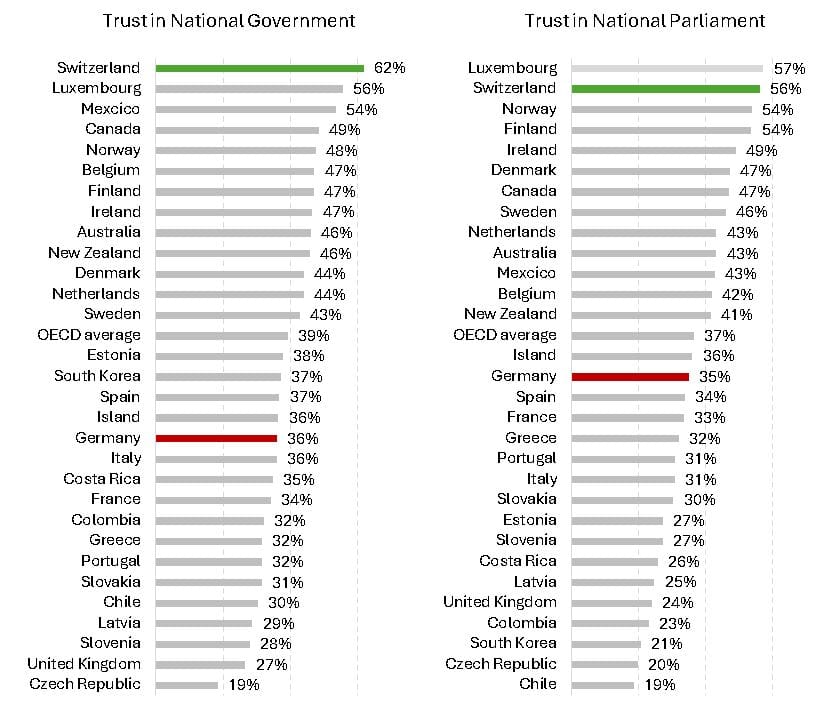
Across the OECD, trust in government has been sliding for nearly twenty years – and the most recent figures show just how far countries diverge. Switzerland sits at the very top, with roughly 62 per cent trusting the national government and 56 per cent trusting parliament (Figure 1).
«Democracy is not dying – it is being outcompeted in the long, quiet stretches between elections, where the real incentives of bureaucracy unfold»
The OECD average itself lies around 39 per cent for governments and 37 per cent for parliaments. Germany sits near this average. Trust in the national government is about 36 per cent, while 35 per cent trust the Bundestag. France is similar, at roughly 34 per cent for both institutions. The United Kingdom sits lower still, at around 27 per cent trust in government and 24 per cent in parliament.
These contrasts matter. They reflect where citizens feel their democratic institutions still work – and where they suspect government has drifted into the self-reinforcing logic of agencies, programmes and subsidies that grow regardless of what voters want.
Figure 1: In most countries the national parliament is less trusted than the national government
Switzerland’s position is not an accident. Its institutions earn trust not because they are flawless, but because they are designed to make government answer to citizens – and, when necessary, fear them – rather than the other way round. Direct democratic instruments, constitutional debt brakes, transparent fiscal rules and a culture of decentralisation create a legal system in which professional lobbyists occasionally win – but cannot entrench themselves without public consent.
What constrains government expansion in Switzerland is not political virtue, but enforceable institutional design anchored in law:
- Binding constitutional “debt brake” (Artikel 126 der Bundesverfassung):The federal budget must be balanced over the economic cycle: total ordinary expenditure may not structurally exceed ordinary receipts.1
- Public expenditure ceiling tied to cyclically adjusted revenue – with oversight and correction mechanisms: The permitted federal expenditure each year is set according to a formula that adjusts for economic conditions; if the government overspends, a “compensation account” requires that excess be offset in later years.2
- Exception for emergencies – but with limits and later compensation: Extraordinary expenditures (e.g. during crises) are possible under the debt brake, but they must be explicitly approved and offset over subsequent years.
- Federal structure and cantonal sovereignty (Artikel 3 der Bundesverfassung): Cantons retain sovereignty over any matters not transferred to the Confederation – meaning many policy spheres (education, policing, local taxes, infrastructure) remain decentralised.3
- Direct-democratic instruments (referenda and initiatives): While the federal level does not permit a financial referendum on all budget items, Switzerland has robust mechanisms for constitutional initiatives and referenda on legislation requiring public approval (e.g. constitutional revisions, major laws).
- Rule-of-law and proportionality constraints on state action (Artikel 5 der Bundesverfassung): The constitution mandates that state activity be in the public interest, proportionate and subject to legal constraints – limiting arbitrary expansion of state power.
- Subsidies in Switzerland are not generally prohibited by federal constitution: While the state is permitted to grant financial assistance, the principle of Economic Freedom (Art. 27 BV) ensures that subsidies cannot be granted arbitrarily. They must be grounded in a specific legal basis (Legalitätsprinzip) and must be justified by a public interest that is proportionate to the resulting restriction on the economic freedom of competitors. Thus, the constitutional framework only imposes conditions to prevent the distortion of fair competition rather than enacting an outright ban.
- Culture of fiscal discipline reinforced by legal commitment and popular consent: The debt brake was approved by around 85 per cent of voters in 2001 – giving the rule strong democratic legitimacy.4
All of this adds up to something most democracies lack: a system where institutions are forced to behave financially the way healthy households or firms must behave. The consequences are visible not only in political culture but also in measurable outcomes.
«Switzerland’s position is not an accident. Its institutions earn trust not because they are flawless, but because they are designed tomake government answer to citizens–and, when necessary, fear them»
Switzerland Sits Almost Alone in a Different Institutional Universe
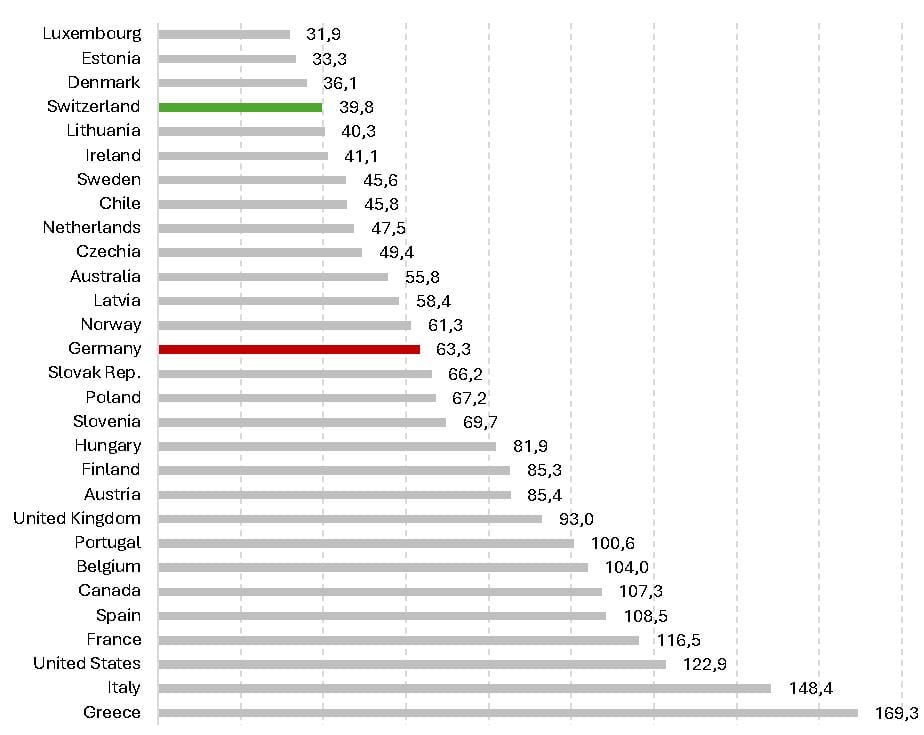
One of the cleanest indicators is government debt as a share of GDP. Between 2014 and 2024, the United States rose to roughly 123 per cent, France exceeded 116 per cent and the United Kingdom reached about 93 per cent. Even Germany – for decades held up as the paragon of fiscal orthodoxy – stands at around 64 per cent (Figure 2).
Switzerland, by contrast, reduced its debt from roughly 43 per cent to just under 40 per cent over the same period. This is not creative accounting. It reflects its constitutional constraint, and it demonstrates that trust in public institutions is not magic. It is engineered through transparent rules, decentralised competition, and direct democratic oversight that impose discipline where other representative democracies allow drift.
Figure 2: Government gross debt in per cent of GDP
In many democracies today, citizens increasingly feel that taxpayer money is wasted – or that state-directed programmes fail to achieve their objectives. The sense of dysfunction corrodes trust, fuels cynicism and gradually disconnects voters from the institutions that are meant to serve them. This is not irrational frustration: in most representative democracies, the legal and fiscal machinery of the state expands faster than citizens can monitor or contest it.
The mechanics are familiar. Laws proliferate. Subsidies accumulate. Technical decisions are quietly delegated to ministries, regulators and arm’s-length agencies. Accountability fragments, while incentives reward the expansion of budgets and mandates rather than their disciplined management.
The result is predictable: those who understand how to monetise democratic and legal complexity always find ways to do so – often in the silent stretches between elections.
My book analyses this ecosystem: the professions and industries that earn their income from interpreting, stretching and multiplying rules. Not through conspiracy or malice – but through incentives embedded in the legal-institutional architecture of modern representative democracies.
Switzerland Is Not Perfect, but It Is More Perfect
Switzerland is not a utopia. It subsidises agriculture, shields failing projects, and decorates mediocre ideas with elegant acronyms. The federal government has 241 separate subsidy channels distributing nearly CHF 47 billion a year; over a third are classified as economically dubious or harmful, including CHF 6.7 billion in clearly welfare-reducing measures and CHF 31.3 billion with ambiguous effects, according to the IWP Subventionsreport 2023.5
The IWP report highlights subsidies to agriculture, film, public transport and multilateral organisations in Geneva that lack convincing justification, sometimes amounting to hundreds of millions of francs a year. The Federal Audit Office has repeatedly reached the same conclusion: many subsidies are insufficiently monitored, insufficiently targeted and insufficiently justified, with weak accountability and patchy oversight across numerous programmes.6
Even When Switzerland Gets It Wrong, It Gets It Wrong Less Badly
In Switzerland, subsidies exist but they do not spiral out of control. They collide with real constraints: the debt brake forces trade-offs, federal decentralisation makes rent-seeking expensive, direct democracy gives voters a veto, and the Legalitätsprinzip prevents subsidies from becoming permanent industrial lobbies. Switzerland lives closer to escape velocity than systems that are democratic in theory but increasingly unaccountable in practice. Even where Switzerland gets it wrong, it gets it wrong less badly. Imperfection with discipline beats perfection on blank cheques.
«In Switzerland, subsidies exist but they do not spiral out of control. They collide with real constraints: the debt brake forces trade-offs, federal decentralisation makes rent-seeking expensive, direct democracy gives voters a veto, and the Legalitätsprinzip prevents subsidies from becoming permanent industrial lobbies»
Swiss Taxes: Opaque but Tolerable Because They Are Low
The Swiss tax system is not transparent. It is a maze of cantonal rates, deductions and stepwise burdens. But unlike Germany, France or the UK, the opacity is not weaponised to confiscate wealth by stealth. The Swiss opacity is tolerated precisely because rates are low. Opaque-and-low feels like imperfect design. Opaque-and-high feels like expropriation.
And opaque-and-high is what corrodes trust – which is why trust has collapsed across the OECD but not in Switzerland.
Dismantling Professional Privilege
In many democracies, certain professions occupy a protected caste position – shielded by tenure, privileged pensions and institutional immunity from reform. Germany’s Beamte system is the clearest expression of this: lifetime status, structurally higher pensions and a political culture in which any suggestion of change triggers outrage and accusations of “Neiddebatte”.7
Switzerland took a different path. Historically, many public roles – teachers included – were appointed under a public-law status with disproportionately strong protections. But from the 1990s onwards, these arrangements were dismantled. The classical Beamtenstatus was replaced with contract-based employment governed by public law. Competence, not caste, became the organising principle. Services continued to function; respect for the professions remained.
The underlying Swiss principle is straightforward: public functions must serve the public, not themselves. That is precisely the kind of institutional reform most representative democracies fear to attempt – and it is one reason Switzerland’s public institutions remain more trusted, more accountable and ultimately more compatible with democratic legitimacy.
State Media – The Test of a Functioning Democracy
State media is the stress test for every modern government. In Switzerland, the test was passed in 2018. Abolish the licence fee? The people voted. Result: 71.6 per cent said no. Every canton stood behind the decision.
The legitimacy of SRG (and SRF within it) lies not in being publicly funded – but in being accepted by public vote. Fast forward to 2025: SRG must cut 900 positions by 2029 due to reduced fees, digital disruption and federal pressure to economise.8 For a public broadcaster to shrink in scope, cost and staff – and do so without existential crisis – is unthinkable in Germany or at the BBC. But in Switzerland, statutory constraints and public legitimacy make such adjustments politically feasible. The No-Billag vote was not a triumph of ideology. It was a triumph of legitimacy. It proved that subsidies endure only where trust endures – and that when constraints press, Switzerland adjusts rather than explodes.
So What Is the Lesson?
Switzerland is not the biblical land of milk and honey, and it certainly does not lack bureaucrats, subsidies or inefficiencies. But it has achieved something profoundly rare among representative democracies: it has put constitutional structure between power and drift. The Swiss system makes government accountable to citizens, not citizens accountable to government.
The Swiss should be proud of this. They have built a political order that others admire but do not execute. Fiscal discipline is enforceable, not rhetorical. Citizens are not spectators but co-owners of governance. Power is distributed rather than hoarded. Accountability is much more real than theatrical.
Europeans (and others) would benefit from understanding this. Switzerland does not need to apply to join the European Union – if anything, Brussels should apply to join Switzerland. Real veto power, enforceable fiscal rules, decentralisation and structural accountability are not Alpine traditions; they are the missing software patches for European democracy.
«Switzerland does not need to apply to join the European Union – if anything, Brussels should apply to join Switzerland»
Well. Germany is my mother country. So what should my fellow citizens do?
First, avoid the grand illusion that Germany can be reformed within its current political architecture. The system is not broken – it is rigid. Laws do not die; they multiply. Every reform ends in preservation of the status quo. Privileges are entrenched, not seriously challenged. Bureaucracy expands, not adapts. Economic opportunity is smothered, not unleashed.
So what remains for Germans – and anyone else caught in the rigid machinery of representative democracy? You can leave the country. You can exit the system economically through crypto. Or you can buy my book – laugh, occasionally cry – and see why Swiss-style constitutional design is the closest thing we have to democratic realism.
Or you can organise for something that sounds impossible: genuine systemic reform, a constitutional redesign that makes Germany look more like Switzerland – perhaps not culturally, but institutionally. If that sounds unrealistic, good. Political realism is the art of lowering expectations until nothing changes.
In the meantime, just read the book.
The Deep State Wants a Hug: How to Lobby Like Crazy and Make Money by Law
Matthias Bauer, Director at ECIPE
The book reveals how modern democracies are quietly outcompeted in the long stretches between elections. It shows how insiders turn legal complexity into reliable income streams.
And it argues that more direct democracy – not culture – offers the closest thing to a solution.
- Schweizerisches Eidgenössisches Finanzdepartement (2025). Schuldenbremse. Verfügbar unter https://www.efd.admin.ch/en/the-debt-brake. ↩
- Schweizerisches Eidgenössisches Finanzdepartement (2025). Schuldenbremse (Finanzpolitik, Grundlagen). Verfügbar unter https://www.efv.admin.ch/en/debt-brake-fp ↩
- Federal Constitution of the Swiss Confederation (Bundesverfassung der Schweizerischen Eidgenossenschaft). Available at https://www.fedlex.admin.ch/eli/cc/1999/404/de. In essence, the Swiss model operates under the principle that if the Federal Constitution does not assign a competence to the Confederation, it remains with the 26 Cantons. ↩
- Swiss Votes (2025). Schuldenbremse (debt brake). Available at https://swissvotes.ch/vote/480.00 ↩
- IWP (2023). IWP-Subventionsreport. Available at https://www.schweizermonat.ch/content/files/admin-iwp-swiss/wp-content/uploads/2023/05/iwp-subventionsreport.pdf ↩
- Federal Finance Administration(EFK, 2024). Subsidies: Summary report of past audits. Available at https://www.efk.admin.ch/en/audit/subsidies-summary-report-of-past-audits ↩
- FR (2025). „Unterste Schublade“: Beamte entsetzt über „Neiddebatte“ um ihre Pensionen. Available at https://www.fr.de/panorama/altersvorsorge-angestellte-beamte-kritik-pensionen-rente-gehalt-neid-ruhestand-zr-93535814.html. ↩
- SRF (2025). SRG streicht 900 Vollzeitstellen bis 2029. Available at https://www.srf.ch/news/schweiz/sparmassnahmen-srg-streicht-900-vollzeitstellen-bis-2029 ↩


